
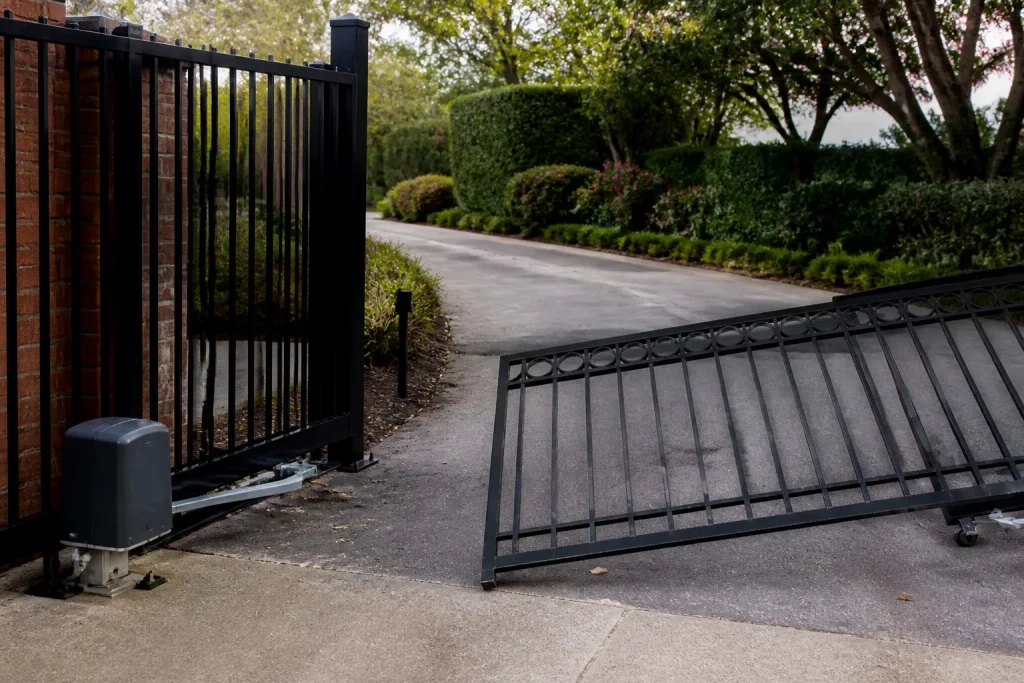
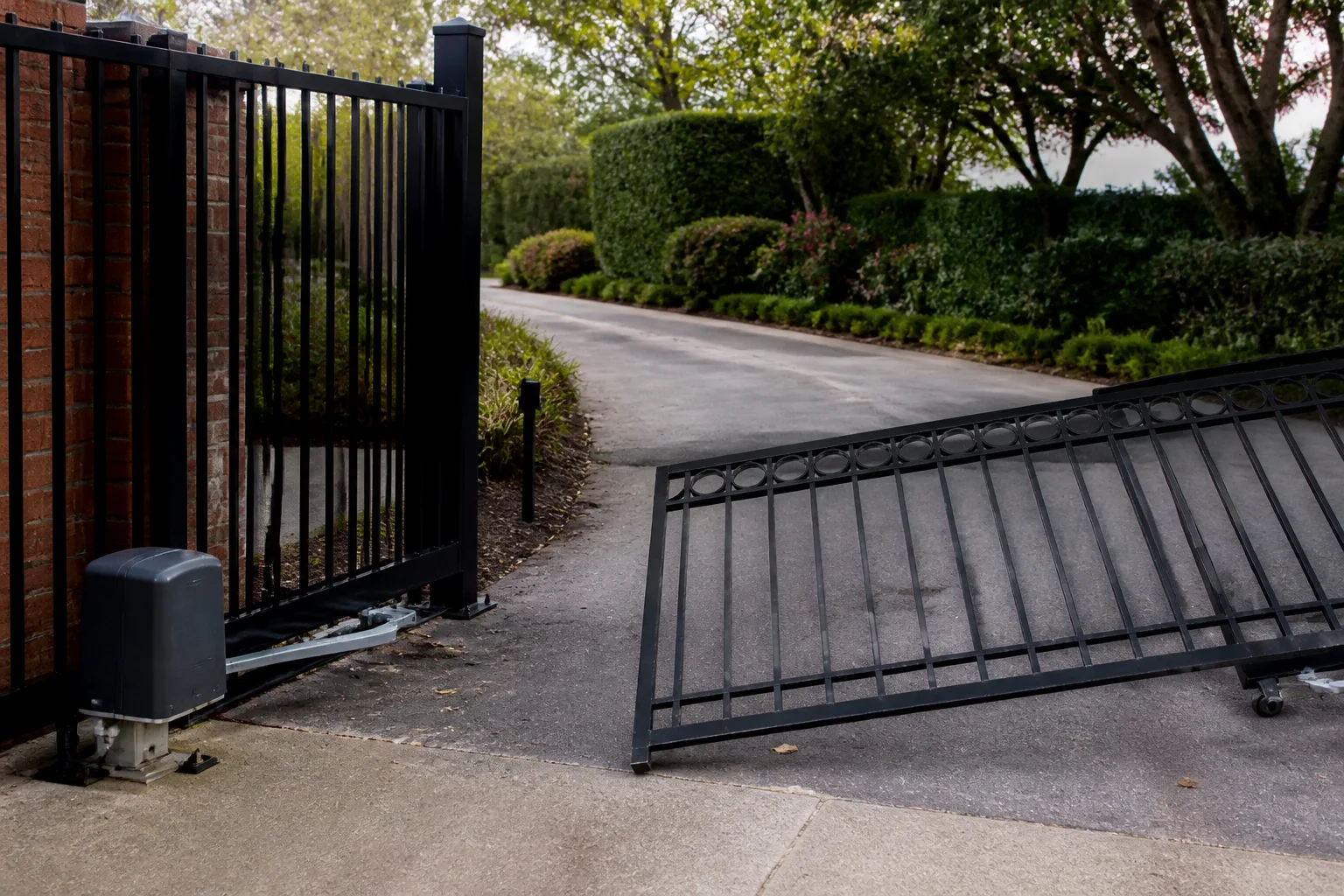
Emergency Gate Repair Near Me: What Virginia Beach Homeowners Should Do First
If your automatic gate stops mid-travel, the first thing to do is stop pressing the remote. Repeatedly cycling a stuck operator is how a cheap sensor fix turns into a motor replacement. Forcing the gate by hand is worse. Every common operator has a manual release, and using it correctly takes about five seconds. We’ve watched homeowners skip that step and pay for it, so here’s the sequence we’d walk you through if you called. If you’d rather not DIY, call (844) 834-3028.
What should you do in the first five minutes of a gate failure?
Stop all commands to the gate, check that no one is under or against it, and identify the manual release before you touch anything else. Not the control board. Not the power switch. The release.
Here’s the order we recommend to every Virginia Beach homeowner who calls us mid-panic:
- Press stop and step back. If the gate is moving, let it finish its cycle or halt it with the control. Don’t grab a moving panel, even a slow one. Sliding gates in particular carry real weight.
- Look for the release. It’s usually a lever, a keyed handle, or a pull cord on the operator housing. On most residential systems it disengages the drive so the gate moves freely by hand.
- Free the gate before you force it. If the release won’t budge, the gate isn’t meant to move right now. Forcing it can strip gears or bend the drive arm.
- Cut power only if the gate is behaving unpredictably. If it’s running on its own, reversing randomly, or the operator is hot to the touch, kill the breaker at the panel and leave it off.
- Note the error lights before you reset anything. Those blinking codes on a LiftMaster or FAAC board are diagnostic gold, and they vanish the moment someone clears them.
That last point matters more than people realize. A technician who knows what the board was showing can often tell you what’s wrong before arriving at your Virginia Beach property.
How do you manually release the most common gate operators?
Each operator releases differently, and doing the wrong one damages the drive mechanism. These are the systems we see most often around Virginia Beach, and the general approach for each.
LiftMaster
Most LiftMaster residential operators use a keyed release or a lever on the housing that disengages the drive. Turn or pull it fully, then move the gate slowly by hand to confirm it’s free. If it still resists, stop and don’t push harder.
FAAC and BFT
These are common on heavier swing gates and small commercial entrances. FAAC and BFT units typically have a manual release accessed with a key or a lever under the housing cap. The release position varies by model, so if you’re not certain which you have, describe the housing to us on the phone and we’ll tell you where to look.
Ghost Controls
Ghost Controls operators generally use a keyed manual release on the arm or housing. It’s straightforward once you find it, but the arm has to be in the right position for the release to engage cleanly.
Apollo and similar swing operators
Apollo-style swing operators often release with a key and a lever at the operator itself. Again, the gate should move by hand with light pressure only. If it doesn’t, the problem isn’t the release.
One universal rule: never dismantle the operator to “get it moving.” The release exists precisely so you don’t have to.
How do you secure an open gate without making the repair worse?
Use what you have: a strap, a bungee, a length of rope, or a cinder block wedged at the base. The goal is a temporary hold, not a permanent fix. Zip ties and rope around the frame are fine. Welding, drilling, or jamming metal into the track is not.
Two things to keep in mind when you’re securing a stuck-open gate in Virginia Beach:
- Don’t block emergency access. If your gate is the only way onto the property, make sure a fire truck or ambulance could still get through. A gate that’s strapped open is safer than one that’s chained shut.
- Don’t stress the drive. Securing the gate against its own motor, so the operator is fighting your strap, will cook the motor. Disconnect the drive with the release first, then secure the gate.
If the gate is on a commercial property or a shared entrance, let the property manager or neighbors know what’s happening so nobody tries to force it open. A short note taped to the housing saves a lot of confusion.
What information should you have ready before you call?
Five data points let a specialist diagnose remotely and show up with the right parts. In our experience, a caller who has these ready saves a full visit:
- Brand and model. Check the housing label or the manual. Mighty Mule, LiftMaster, FAAC, and BFT all have distinctive housings, and a photo of the label is even better.
- Last normal behavior. Did it open fully? Did it reverse halfway? Was it slow before it quit? This tells us whether the issue is in the control board, a sensor, or the drive itself.
- Error lights. Note which LEDs are lit or blinking, and what color. That’s often the single most useful thing you can tell us.
- Recent weather. Heavy rain, a wind storm, or a temperature swing can shift a gate on its hinges or trip a safety sensor. In Virginia Beach, a stretch of wet weather followed by a clear day is a common setup for a gate that suddenly won’t close.
- What you’ve already tried. If you pressed reset, cycled the remote, or flipped the breaker, say so. Otherwise we’re diagnosing blind.
With those five points, we can often tell whether the problem is a photo-eye, a limit switch, a control board, or the motor itself before we get there.
Is your gate failure a same-day emergency or a next-morning appointment?
It’s a same-day emergency if someone could be hurt or the property is genuinely exposed. Everything else can usually wait for a scheduled visit.
Here’s how we draw the line for Virginia Beach homeowners and property managers:
Call now if:
- The gate is moving on its own or won’t stop.
- A heavy panel is off its track or hanging.
- The gate is stuck open and the property is exposed overnight.
- There’s a burning smell, smoke, or the operator is hot to the touch. Cut power at the breaker first.
- Someone is trapped on the wrong side and there’s no other way out.
It can usually wait for a scheduled visit if:
- The gate is stuck open but you can secure it safely.
- The gate works by remote but not by keypad.
- The gate works but the safety sensors are acting up.
- The gate is slow or noisy but still operating.
We answer 24/7. A call outside dispatch hours is booked into the next opening, Sunday through Friday, 7am to 7pm.
When should you call a pro, and what does a gate specialist actually bring?
Call a pro the moment the failure involves wiring, the control board, or a heavy panel off its track. Those are the situations where a homeowner’s fix turns into a bigger repair. For the rest, an on-site estimate from a specialist tells you what’s actually wrong instead of what a generalist guesses.
This is the gap most people don’t see until they’ve been through it. A general home-service company shows up with a multimeter and a van full of garage door parts. If your operator is a BFT or a DoorKing, they may not have the board, the limits, or the sensors for it. We’ve heard the “we’ll need to order that” line plenty. An electric gate repair specialist works on gates as a dedicated trade, not as one service line among many.
That matters more on some brands than others. Mighty Mule, LiftMaster, FAAC, BFT, and the rest each have their own logic, their own error codes, and their own failure patterns. A technician who works across all of them can diagnose on-site instead of guessing.
Related services in Virginia Beach: if the gate needs more than a repair, we also handle installation and full gate repair on residential and commercial systems across the Virginia Beach area.
Our technicians have up to 14 years of experience across nine major gate brands, including LiftMaster, FAAC, BFT, Linear, Viking, Ghost Controls, DoorKing, Elite, and Mighty Mule. That’s the depth we built the whole business around. If you’re curious how we approach this, you can read more about Ashton Gate Repair and what we do.
The Bottom Line
The first five minutes are the ones that decide the bill. Stop pressing the remote. Find the release. Note the error lights. Don’t force the gate, don’t dismantle the operator, and don’t secure the gate against its own motor. Get the brand, the model, and the last normal behavior in hand before you call anyone.
If you’re in Virginia Beach and need help, Ashton Gate Repair offers free estimates. Call (844) 834-3028. We answer 24/7. Fast dispatch from 7am to 7pm, Sunday through Friday. We work on the gate you have, not the one we’d prefer to sell.
Frequently Asked Questions
No. Use the manual release first, then move the gate by hand with light pressure. Forcing it while the drive is engaged is the fastest way to strip gears or bend the drive arm, which can turn a small fix into a motor replacement.
It’s usually a keyed handle or lever on the operator housing. LiftMaster, FAAC, BFT, and Ghost Controls all place it differently, so check the housing cap first and describe the unit to a technician if you can’t find it. Never dismantle the operator to reach it.
Call now if the gate is moving on its own, a panel is off its track, or the property is exposed overnight. For a gate that’s stuck open but secure, a scheduled visit is enough. We answer 24/7, and a call outside dispatch hours is booked into the next opening, Sunday through Friday, 7am to 7pm.
Because the technician didn’t carry parts for your operator. A generalist may not stock boards or sensors for Mighty Mule, FAAC, BFT, or DoorKing. A gate-only specialist who works across all of them is more likely to diagnose and repair on the first visit. Call (844) 834-3028 for a free estimate.
Written by the team at Ashton Gate Repair.
Need Gate Repair Help?
Call Ashton Gate Repair - licensed & insured, here with fast help in Virginia Beach.
(844) 834-3028